
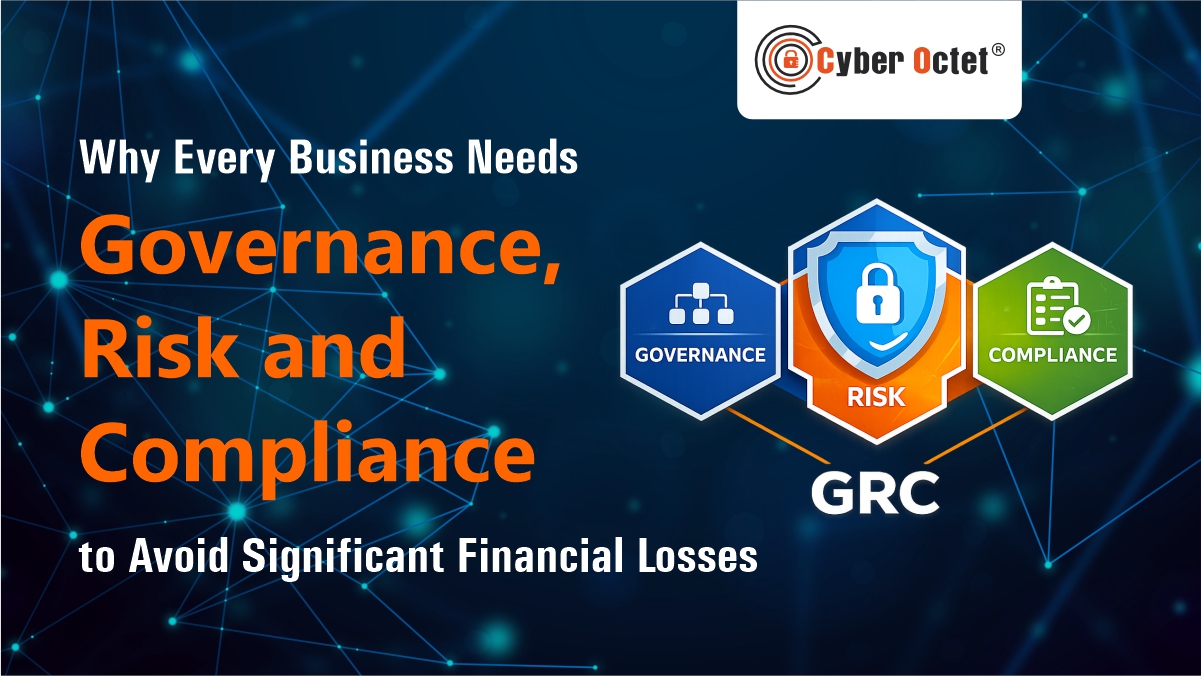
Why Every Business Needs Governance, Risk, and Compliance to Avoid Costly Surprises
Introduction : The Illusion of Control
Most organizations believe they are in control until they are not.
A surprise audit finding.
A regulator’s notice.
A cyber incident that escalates faster than leadership can respond.
A vendor failure that exposes sensitive data.
Understanding the implications of GRC can prevent substantial financial penalties.
These moments rarely come from nowhere. They are usually the result of gaps that were known, ignored, misunderstood, or deprioritized. What makes them costly is not just the event itself, but the realization that the organization should have seen it coming.
Governance, Risk, and Compliance (GRC) exists precisely to prevent these surprises. Yet many businesses still treat it as a checkbox exercise, an annual burden, or a compliance-only function disconnected from real operations.
By implementing GRC frameworks effectively, businesses can mitigate risks and enhance compliance.
In today’s environment, where digital dependency, regulatory scrutiny, and threat activity intersect, GRC is no longer a background function. It is a core business discipline that directly affects resilience, reputation, and decision-making.
It is crucial for companies to continually assess their GRC strategies to stay ahead of potential threats.
This article explores why every business needs a mature GRC approach, why traditional models often fail, and how organizations can move toward practical, defensible risk management.
Understanding Governance, Risk, and Compliance (Beyond the Acronyms)
At its core, GRC is about how an organization makes decisions, manages uncertainty, and demonstrates accountability.
- Governance defines who decides, how decisions are made, and how accountability is enforced.
- Risk management identifies what could go wrong, how likely it is, and what impact it could have on business objectives.
- Compliance ensures that obligations legal, regulatory, contractual, or internal are met consistently.
When done well, GRC is not a set of documents or tools. It is an operating mindset embedded into leadership discussions, operational processes, and day-to-day behavior.
A mature GRC program helps organizations answer critical questions:
- Do we know our most significant risks?
- Are controls working as intended?
- Can we explain and defend our decisions to regulators, customers, and boards?
- Are we reacting to issues or managing them proactively?
Without clear answers, organizations are exposed often without realizing it.
Why Traditional GRC Approaches Fall Short
Many GRC programs fail not because they are unnecessary, but because they are misaligned with how businesses actually operate.
1. Compliance Without Context
Traditional GRC often focuses heavily on passing audits rather than reducing real risk. Policies are written, controls are documented, and evidence is collected, yet operational teams may not understand why these controls exist or how they protect the business.
As a result, compliance becomes performative rather than protective.
2. Risk Registers That No One Uses
Effective GRC practices ensure organizations are not only compliant but also resilient.
Risk registers filled with generic statements like “cyber risk” or “operational risk” provide little value. When risks are not clearly linked to business outcomes revenue disruption, regulatory penalties, or service downtime, leaders struggle to prioritize or act on them.
3. Siloed Ownership
Governance teams, security teams, IT teams, and business units often operate independently. Risks identified in one area may never reach decision-makers in another. This fragmentation leads to blind spots and delayed responses.
4. Over-Reliance on Tools
GRC platforms can help organize data, but they cannot replace judgment, accountability, or leadership engagement. Many organizations invest in tools without establishing the processes and discipline needed to use them effectively.
The result is a false sense of security; controls exist on paper, but their effectiveness is untested.
Real-World Scenarios: Where GRC Gaps Become Costly
Costly surprises often follow predictable patterns. Consider the following scenarios:
Scenario 1: The “Compliant” Breach
An organization passes its annual security audit but experiences a data breach weeks later. Investigations reveal that while controls were documented, access reviews were not consistently performed, and exceptions were never reassessed.
The issue was not a lack of compliance, it was a lack of governance and ongoing risk oversight.
Scenario 2: Third-Party Risk Escalation
A trusted vendor suffers a cyber incident, exposing customer data. Contracts contained security clauses, but no one monitored whether the vendor’s controls remained effective over time.
The business faces reputational damage and regulatory scrutiny for risks it assumed were “outsourced.”
Scenario 3: Regulatory Surprise
A new regulation comes into effect, and the organization scrambles to respond. Leadership assumed compliance was handled, but responsibilities were unclear, impact assessments were incomplete, and evidence was scattered across teams.
Penalties are avoidable, but only if preparation had started earlier.
These scenarios are not edge cases. They are common across enterprises and government agencies alike.
The Business Impact of Weak GRC
When GRC is weak or misaligned, the impact extends beyond security teams.
- Financial losses from fines, legal costs, and operational disruption
- Leadership distraction during incidents and audits
- Delayed decision-making due to unclear risk ownership
- Loss of trust from customers, regulators, and partners
- Reduced agility as teams operate defensively rather than confidently
Conversely, organizations with strong GRC foundations experience fewer surprises, not because they eliminate risk, but because they manage it consciously.
How Effective GRC Strengthens Security Maturity
Security maturity is not measured by the number of tools deployed but by how well risks are understood and controlled over time.
Effective GRC contributes to maturity in several ways:
1. Clear Risk Prioritization
Instead of treating all risks equally, mature organizations focus on what truly matters: risks that could materially impact mission, revenue, or public trust.
2. Defensible Decision-Making
When incidents occur, leaders can explain why certain risks were accepted and how decisions aligned with business priorities. This defensibility matters more than perfection.
3. Continuous Oversight
Controls are monitored, exceptions are reviewed, and assumptions are challenged regularly. Risk management becomes a living process, not an annual exercise.
4. Stronger Executive Engagement
GRC provides leadership with actionable insight, not technical detail, enabling informed decisions rather than reactive responses.
Governance as a Business Enabler, Not a Constraint
One of the biggest misconceptions about GRC is that it slows business down. In reality, unclear governance creates friction.
When roles, responsibilities, and escalation paths are defined:
- Decisions happen faster
- Accountability is clearer
- Teams operate with confidence
Governance does not eliminate risk; it ensures that risk-taking is intentional and aligned with strategy.
The Future Relevance of GRC
The importance of GRC will only increase.
- Regulations are expanding, not shrinking
- Supply chains are becoming more interconnected
- Cyber incidents are escalating in scale and complexity
- Boards and executives are being held personally accountable
In this environment, organizations that treat GRC as a strategic function will outperform those that view it as a compliance cost.
Future-ready GRC programs will be:
Investing in GRC is investing in the future of the organization.
- Integrated with business planning
- Focused on outcomes, not artifacts
- Human-led, not tool-driven
- Designed for adaptability, not static compliance
Cyber Octet’s View : Focus on Defensibility, Not Perfection
One of the most important lessons we emphasize is this: auditors, regulators, and boards do not expect perfection.
They expect :
- Awareness of risk
- Consistency in decision-making
- Evidence that controls are purposeful
- Accountability when things do not go as planned
Defensibility matters more than theoretical compliance.
A mature GRC program does not prevent all incidents. It ensures that when incidents occur, leadership can demonstrate that risks were understood and managed responsibly.
Final Takeaway : No More Surprises
Surprises are expensive, not just financially, but strategically.
Governance, Risk, and Compliance is not about avoiding every issue. It is about ensuring that when issues arise, they are expected, understood, and manageable.
Organizations that invest in practical, business-aligned GRC do not eliminate uncertainty, but they remove shock.
And in today’s risk environment, that difference matters.


