


Offensive Security

Identify Exposure Before It Becomes Business Risk

Modern organisations operate across interconnected applications, APIs, networks, cloud environments, mobile platforms and connected devices. Each technology expands the attack surface and can introduce weaknesses that remain unnoticed until they are exploited.

Cyber Octet’s Offensive Security services provide an independent, evidence-based assessment of your security posture. We identify exploitable weaknesses, validate their potential business impact and provide practical remediation priorities helping security teams focus resources where they matter most.

The Business Imperative new

The Business Imperative

Security controls may appear effective until tested against realistic attack scenarios. Configuration weaknesses, insecure code, excessive privileges, exposed services and vulnerabilities across interconnected systems can create attack paths that conventional reviews may overlook.

Independent security testing helps organisations answer three important questions: Where are we exposed? What could an attacker realistically exploit? What should we fix first?

th business e1787250404322
Cyber Octet

CAPABILITIES

Comprehensive security testing across your evolving digital attack surface.

project icon3

Vulnerability Assessment & Penetration Testing (VAPT)

Identify, validate and prioritise vulnerabilities across critical technology environments.

project icon3

Web Application Security Testing

Assess application controls, authentication, business logic and security weaknesses.

project icon3

Mobile Application Security Testing

Evaluate mobile applications, data storage, APIs and platform security controls.

project icon3

API Security Testing

Identify authentication, authorisation, data exposure and business logic weaknesses.

project icon3

Network Security Assessment

Identify infrastructure vulnerabilities, insecure configurations and potential attack paths.

project icon3

Wireless Security Testing

Assess wireless access, encryption and configurations for exploitable weaknesses.

project icon3

Cloud Security Assessment

Identify cloud misconfigurations, excessive permissions and security control gaps.

project icon3

IoT Security Assessment

Assess connected devices, interfaces, communications and supporting infrastructure.

project icon3

Source Code Review

Detect security weaknesses in application code before they become exploitable.

project icon3

Red Team Assessment

Simulate real-world attacks to test prevention, detection and response capabilities.
What You Receive

Every engagement is designed to convert technical findings into actionable security decisions.

Scope & Engagement Document

Clear scope, objectives and rules of engagement.

Executive Summary

Board-ready view of key risks and business impact.

Technical Assessment Report

Detailed findings, evidence and affected assets.

Validated Findings & Evidence

Verified vulnerabilities supported by technical evidence.

Risk Ratings & Prioritisation

Findings prioritised by severity, exploitability and impact.

Proof of Concept

Demonstration of exploitability, where appropriate.

Remediation Roadmap

Prioritised actions to address identified weaknesses.

Risk Register

Structured visibility of identified security risks.

Retesting & Validation

Confirmation that remediation has effectively addressed findings.

Knowledge Transfer & Support

Expert guidance, clarification and postengagement support.

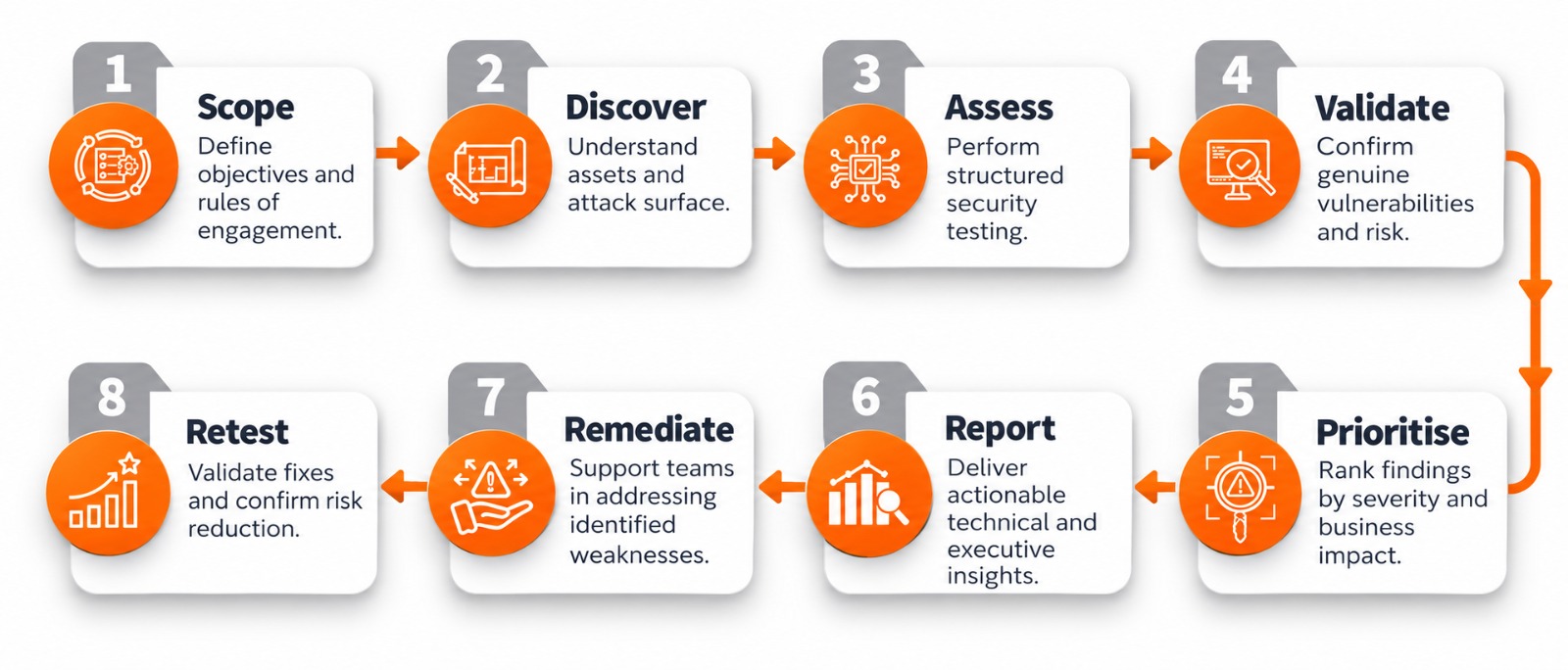
Our Delivery Approch

offancive delivery

Why Choose Cyber Octet?

Years Experience
0 +
Organizations Served
0 +
Threats Blocked
0 +
Data Breaches
0

Talk to Cyber Security Expert Today.

Trusted by Global Brands

Cyber Octet

FAQ's

<br />
<b>Warning</b>:  Undefined variable $tg_image_alt in <b>/srv/stackserver/unix1719906959/htdocs/wp-content/plugins/solutek-core/include/elementor/faq.php</b> on line <b>503</b><br />

1. What is Offensive Security in cybersecurity?

Offensive Security is a proactive cybersecurity approach used to identify, test and validate security vulnerabilities before attackers can exploit them. It involves controlled security testing of web applications, APIs, networks, cloud environments, mobile applications, wireless infrastructure and connected devices.
Offensive Security helps organisations understand how attackers could gain access to systems, exploit weaknesses and impact business operations.

2. Why does my organisation need Offensive Security testing?

Offensive Security testing helps organisations identify exploitable vulnerabilities, insecure configurations, weak access controls, excessive privileges and potential attack paths before they are used in a real cyberattack.
Regular security testing can help reduce cyber risk, strengthen security controls and improve the organisation’s overall security posture.

3. What is VAPT and how does it work?

Vulnerability Assessment and Penetration Testing (VAPT) is a cybersecurity assessment that combines vulnerability identification with controlled exploitation.
A Vulnerability Assessment identifies and prioritises potential security weaknesses, while Penetration Testing determines whether those vulnerabilities can actually be exploited. Together, VAPT provides organisations with a clearer understanding of their real-world cyber risk.

4. What types of Penetration Testing and Offensive Security services do you provide?

Our Offensive Security and Penetration Testing services include:
  • Vulnerability Assessment & Penetration Testing (VAPT)
  • Web Application Penetration Testing
  • API Security Testing
  • Mobile Application Security Testing
  • Network Security Assessment
  • Wireless Security Testing
  • Cloud Security Assessment
  • IoT Security Assessment
  • Source Code Security Review
  • Red Team Assessment
The scope of testing can be customised according to the organisation’s technology environment, business requirements and security objectives.

5. What is covered in Web Application and API Security Testing?

Web Application Security Testing evaluates vulnerabilities related to authentication, authorisation, session management, access control, input validation, business logic and application security controls.
API Security Testing focuses on weaknesses such as broken authentication, broken authorisation, excessive data exposure, insecure access controls, improper input handling and business logic vulnerabilities within APIs and connected services.

6. Do you provide Network, Wireless and Cloud Security Assessments?

Yes. Network Security Assessments identify vulnerable services, insecure configurations, exposed systems and potential attack paths within network infrastructure.
Wireless Security Testing evaluates Wi-Fi security controls, encryption and access configurations, while Cloud Security Assessments help identify cloud misconfigurations, excessive permissions, exposed resources and gaps in cloud security controls.

7. What is a Red Team Assessment?

A Red Team Assessment is an advanced security exercise that simulates realistic cyberattack scenarios to evaluate how effectively an organisation can prevent, detect and respond to attacks.
Unlike a standard vulnerability assessment, Red Teaming can combine multiple vulnerabilities and attack techniques to demonstrate possible attack paths and test the effectiveness of existing security controls and incident response capabilities.

8. How do you identify real vulnerabilities and reduce false positives?

Our security assessments combine automated security testing with manual analysis and technical validation.
Potential vulnerabilities are reviewed by security professionals and, where appropriate, validated using controlled Proof-of-Concept techniques. This helps eliminate false positives and provides technical evidence showing whether a vulnerability presents a genuine security risk.

9. What deliverables will we receive after a Penetration Testing or VAPT assessment?

Depending on the agreed scope, an Offensive Security assessment may include:
  • Executive Summary
  • Detailed Technical VAPT Report
  • Validated Vulnerabilities
  • Technical Evidence
  • Risk Ratings and Prioritisation
  • Proof-of-Concept Evidence
  • Remediation Recommendations
  • Remediation Roadmap
  • Risk Register
  • Retesting Results
  • Post-assessment Support
The objective is to provide both management and technical teams with clear visibility of identified risks and practical remediation priorities.

10. Do you provide vulnerability remediation support and retesting?

Yes. Each validated finding includes practical remediation recommendations to help technical and security teams address the identified vulnerability.


After remediation is completed, retesting can be performed to verify whether the vulnerability has been successfully resolved and whether the associated security risk has been reduced.

faq2
faq2