
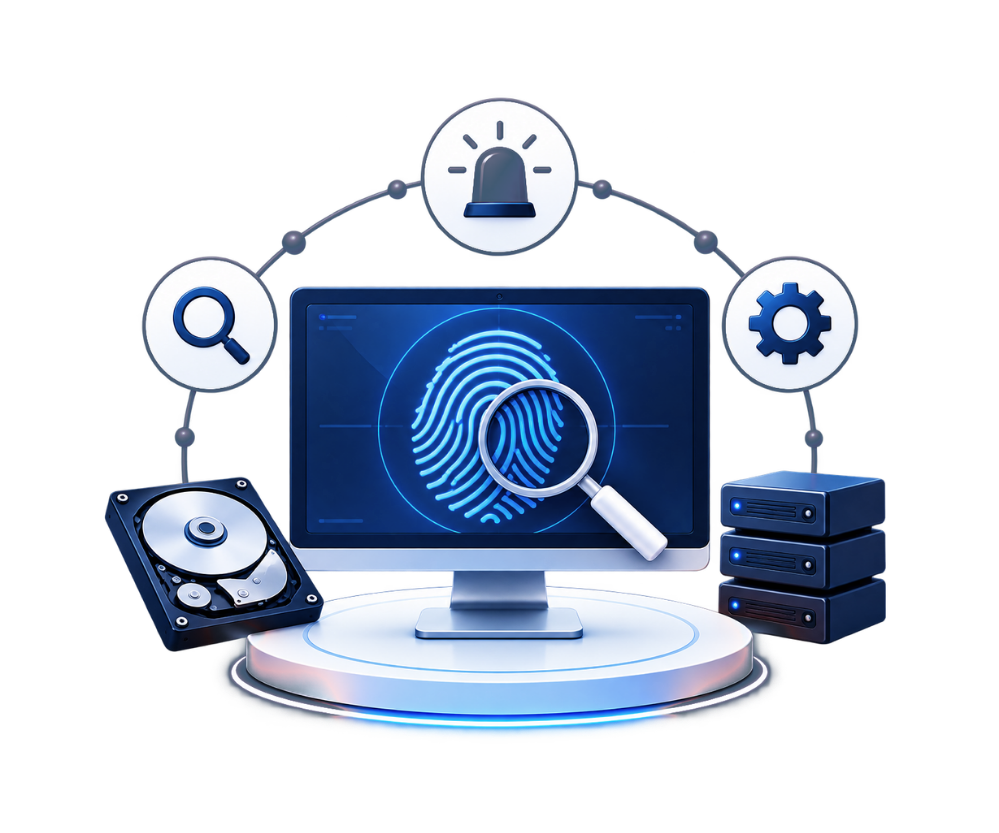

Digital Forensics & Incident Response

Investigate with Evidence. Respond with Control. Recover with Confidence.

When a cyber incident occurs, organisations need reliable facts and decisive action quickly.

Cyber Octet provides Digital Forensics & Incident Response services to help organisations investigate incidents, preserve critical evidence, determine the scope and root cause, support containment, and make informed recovery decisions.

Our structured approach combines forensic investigation, evidence preservation and incident response expertise to help organisations respond effectively while maintaining the integrity of critical evidence.

Digital Forensics Incident Response

The Business Imperative

Poorly coordinated incident response can increase downtime, compromise valuable evidence and delay effective recovery.

A structured, evidence-led response helps organisations understand what happened, contain the threat, assess the impact and take appropriate corrective action.

Effective incident response requires three capabilities working together:

digital business
Cyber Octet

CAPABILITIES

Comprehensive forensic investigation and incident response capabilities to uncover facts, preserve evidence and support effective response.

project icon3

Cybercrime Investigation

Investigate cyber incidents to establish facts, scope and supporting evidence.

project icon3

Incident Response

Support rapid containment, investigation and coordinated response to cyber incidents.

project icon3

Digital Evidence Collection & Preservation

Collect and preserve digital evidence while maintaining integrity and traceability.

project icon3

Disk Forensics

Examine storage media to identify, recover and analyse relevant digital evidence.

project icon3

Memory Forensics

Analyse volatile memory to uncover malicious activity and forensic artefacts.

project icon3

Network Forensics

Analyse network activity to identify suspicious behaviour and incident indicators.

project icon3

Email Investigation

Investigate suspicious emails, headers, attachments and related evidence.

project icon3

Malware Analysis

Analyse malicious files and behaviour to understand threats and potential impact.

project icon3

OSINT Investigation

Use open-source intelligence to support investigations and gather relevant information.

project icon3

Ransomware Investigation

Investigate ransomware incidents to determine scope, impact and potential attack vectors.

project icon3

Root Cause Analysis

Identify how an incident occurred and determine contributing security weaknesses.

project icon3

Incident Reporting

Document findings, evidence, impact and recommended corrective actions.

What You Receive

Engagement Deliverables. Depending on the scope, typical deliverables may include:

Incident Assessment

Initial assessment of incident scope, severity and potential impact.

Evidence Collection Records

Documented records of collected and preserved digital evidence.

Forensic Analysis Report

Detailed findings from forensic examination and investigation.

Timeline of Events

Chronological reconstruction of key incident activities.

Indicators of Compromise (IoCs)

Identified indicators associated with malicious activity.

Root Cause Analysis

Identification of how the incident occurred and contributing factors.

Affected Asset Assessment

Evaluation of impacted systems, data and technology assets.

Malware Analysis Findings

Findings related to malicious files, behaviour and potential impact.

Containment Recommendations

Prioritised actions to control and limit further impact.

Recovery Guidance

Recommended actions to support secure restoration and recovery.

Executive Incident Summary

Leadership-level overview of incident findings and impact.

Post-Incident Improvement Plan

Recommended actions to strengthen future incident readiness.

Our Delivery Approch

digital delivery

Why Choose Cyber Octet?

Years Experience
0 +
Organizations Served
0 +
Threats Blocked
0 +
Data Breaches
0

Talk to Cyber Security Expert Today.

Trusted by Global Brands

Cyber Octet

FAQ's

<br />
<b>Warning</b>:  Undefined variable $tg_image_alt in <b>/srv/stackserver/unix1719906959/htdocs/wp-content/plugins/solutek-core/include/elementor/faq.php</b> on line <b>503</b><br />

1. What is Digital Forensics and Incident Response (DFIR)?

Digital Forensics and Incident Response (DFIR) is a specialised cybersecurity discipline that combines digital forensic investigation with cyber incident response.
DFIR helps organisations determine what happened during a cybersecurity incident, identify affected systems, understand the root cause, preserve digital evidence, contain threats and support secure recovery.

2. When should an organisation engage a DFIR or cyber incident response team?

An organisation should consider engaging a Digital Forensics and Incident Response team when it experiences or suspects:
  • Unauthorised system access
  • Malware infection
  • Ransomware attack
  • Data breach or data compromise
  • Suspicious email activity
  • Account compromise
  • Security breach
  • Other unexplained malicious activity
Early DFIR involvement can help contain threats, preserve important digital evidence and determine the facts surrounding an incident.

3. What types of Digital Forensics and cyber investigations do you provide?

Our Digital Forensics and Incident Response capabilities include:
  • Cybercrime Investigation
  • Digital Evidence Collection & Preservation
  • Disk Forensics
  • Memory Forensics
  • Network Forensics
  • Email Investigation
  • Malware Analysis
  • Ransomware Investigation
  • OSINT Investigation
  • Root Cause Analysis
The forensic approach is determined by the nature, severity and scope of the cybersecurity incident.

4. How is digital evidence collected and preserved during a cyber investigation?

Digital evidence is collected using structured forensic processes designed to maintain evidence integrity and traceability.
Appropriate evidence handling and collection records help document what evidence was collected, its source and how it was handled throughout the investigation.

5. What is the difference between Disk Forensics, Memory Forensics and Network Forensics?

Disk Forensics examines storage devices and file systems to identify, recover and analyse relevant digital evidence.
Memory Forensics examines volatile system memory to identify malicious processes, activity and forensic artefacts that may not be available on disk.
Network Forensics analyses network communications and activity to identify suspicious behaviour, attack patterns and indicators related to a cybersecurity incident.

6. Can you investigate malware, ransomware and phishing emails?

Yes. Malware Analysis examines suspicious or malicious files and their behaviour to understand the nature and potential impact of a threat.
Ransomware Investigation helps establish the scope, impact and possible attack vectors associated with a ransomware incident.
Email Investigation analyses suspicious emails, headers, attachments and associated evidence to identify potential phishing, compromise or malicious activity.

7. How do you determine the root cause of a cybersecurity incident?

Root Cause Analysis involves examining available digital evidence, system activity, network activity and other relevant information to reconstruct the sequence of events surrounding a cybersecurity incident.
The investigation can help identify the incident timeline, affected assets, Indicators of Compromise (IoCs), contributing security weaknesses and the likely root cause of the incident.

8. How do you support cyber incident containment and recovery?

Our Incident Response support focuses on rapid triage, investigation, containment and coordinated response while considering business and operational continuity.
Evidence-based recommendations are provided to limit further impact, securely restore affected systems and support informed recovery decisions.

9. What deliverables will we receive after a Digital Forensics or Incident Response engagement?

Depending on the scope of the investigation, DFIR deliverables may include:
  • Incident Assessment
  • Digital Evidence Collection Records
  • Digital Forensic Analysis Report
  • Incident Timeline
  • Indicators of Compromise (IoCs)
  • Root Cause Analysis
  • Affected Asset Assessment
  • Malware Analysis Findings
  • Containment Recommendations
  • Recovery Guidance
  • Executive Incident Summary
  • Post-Incident Improvement Plan

10. How can DFIR improve cybersecurity after an incident?

Digital Forensics and Incident Response helps organisations understand what happened, how attackers gained access, which systems were affected and what security weaknesses contributed to the incident.
Investigation findings can then be converted into corrective actions, stronger security controls and improved incident response procedures, helping organisations reduce the likelihood and impact of similar cybersecurity incidents in the future.

faq2
faq2